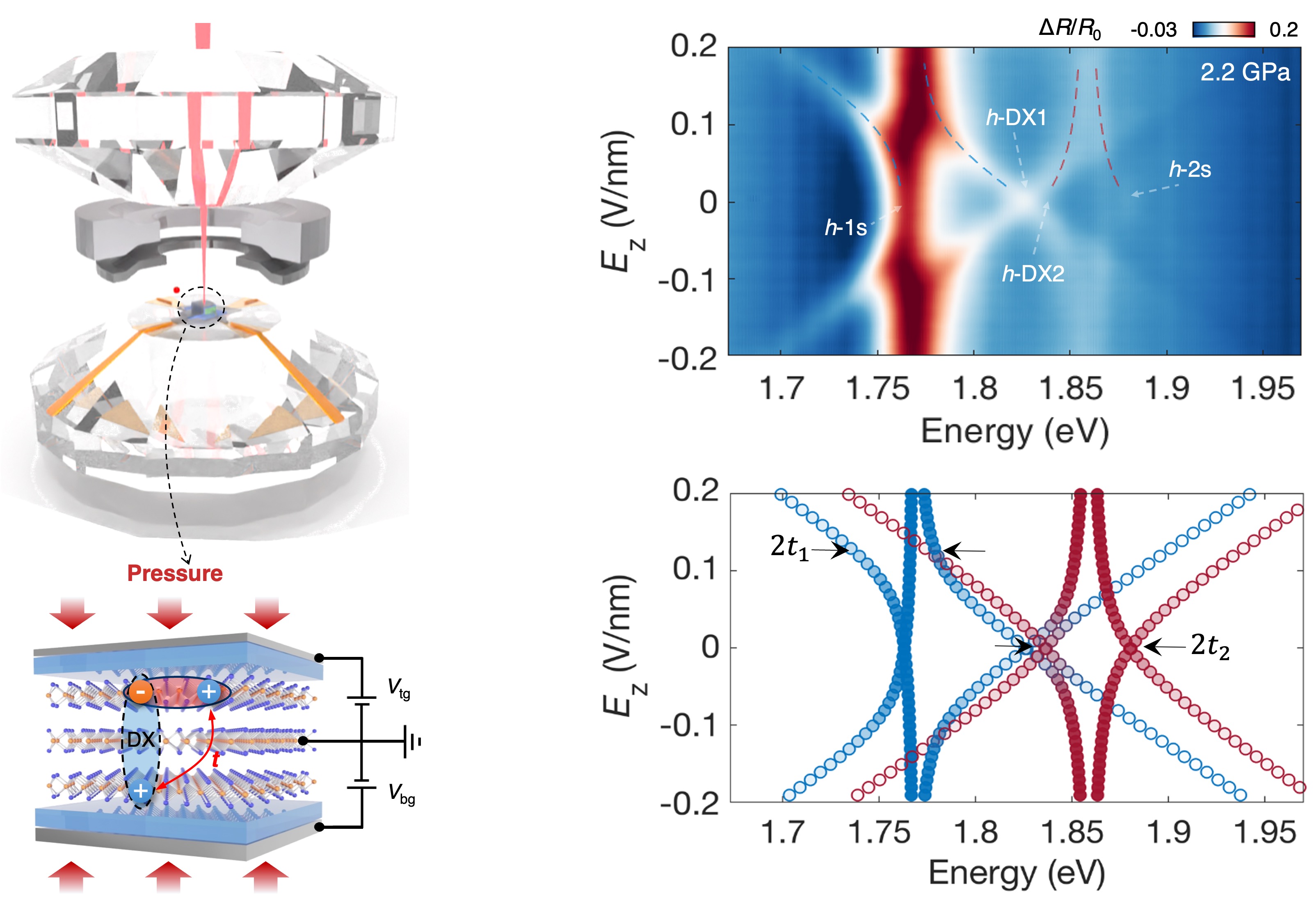
van der Waals (vdW) forces in two-dimensional materials allow for versatile control over interlayer coupling, enabling the exploration of novel emergent quantum states and device functionalities. Here, using microreflectance spectroscopy in a diamond anvil cell, we demonstrate dynamic pressure tuning of layer-hybridized excitons in dual-gated trilayer WSe2 devices up to 6.6 GPa. Pressure-controlled interlayer coupling manifests as enhanced energy-level anticrossings and oscillator strength redistribution between the intralayer and interlayer excitons. We observe an 11% reduction in the interlayer exciton dipole moment, while the coupling strength triples (from ∼10 to >30 meV), following a near-linear scaling of 3.5 ± 0.2 meV/GPa. Spectral density simulations resolve four distinct components of hybridized excitons, i.e., intralayer ground/excited and interlayer ground/excited states, with their relative weights transitioning from one component dominant to strongly mixed at higher pressures. Our findings highlight the potential for controlling excitonic properties and engineering optoelectronic devices through interlayer compression.
Chern insulators are topologically non-trivial states of matter characterized by incompressible bulk and chiral edge states. Incorporating topological Chern bands with strong electronic correlations provides a versatile playground for studying emergent quantum phenomena.
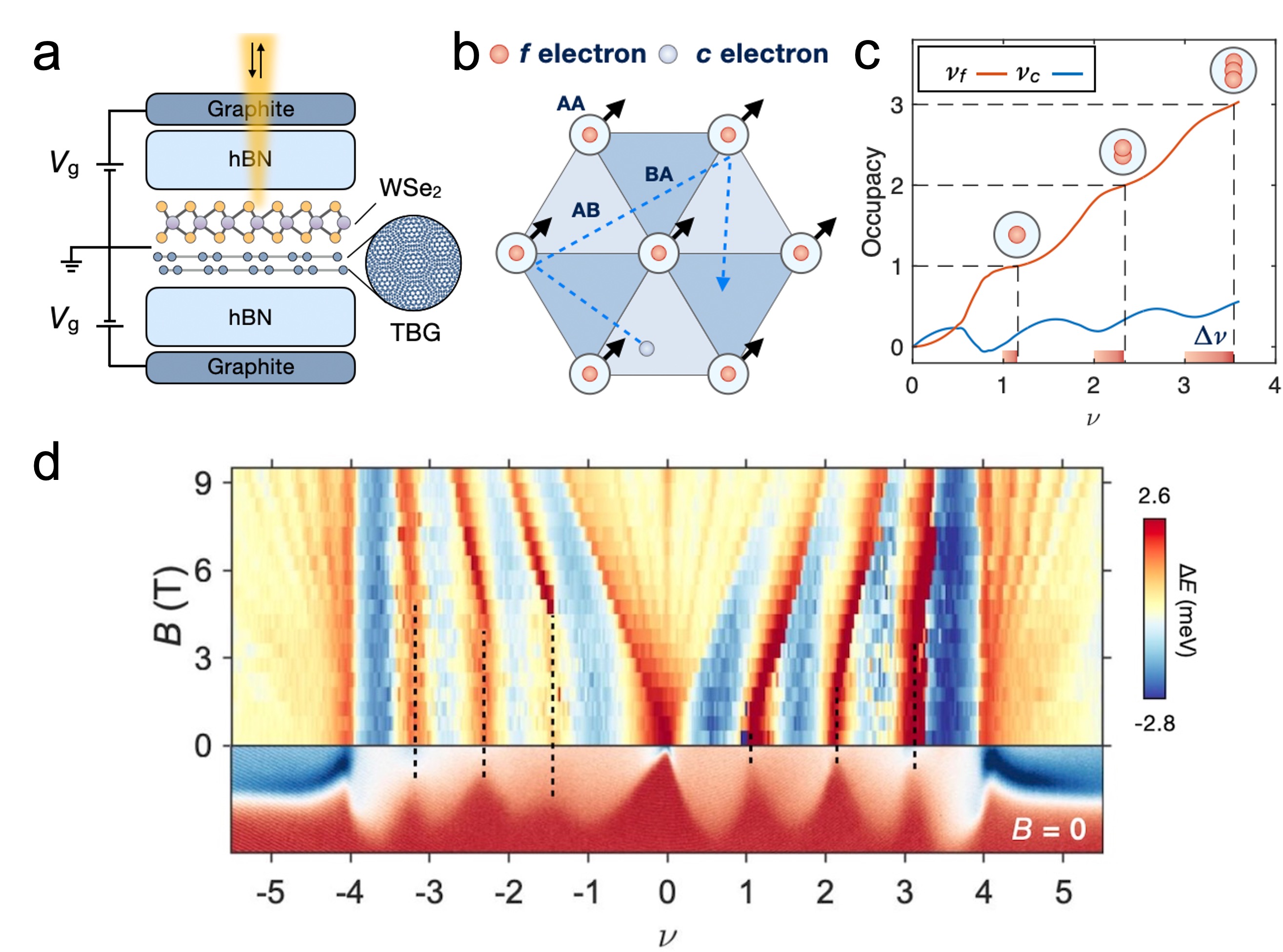
At high magnetic field, we observe correlated Chern insulators, which we show are linked with zero-field cascade features in the electronic compressibility.